SCMerge: Spatial-Consistency-Aware Token Pair Merging for Efficient Semantic Segmentation
- 1 Southern University of Science and Technology
- 2 Shenzhen Technology University
arXiv preprint, arXiv:2610.21642
Overview
Vision Transformers are effective for semantic segmentation, but self-attention scales quadratically with the number of tokens. Most training-free token merging methods pair tokens by feature similarity alone, which can merge tokens that look alike but are spatially inconsistent—for example, mixing boundary tokens with neighboring interiors, or merging interiors of different objects.
We propose SCMerge, a training-free, plug-and-play token merging method for ViT-based segmentation. It jointly considers feature similarity and spatial consistency when pairing tokens, merges the selected pairs inside the encoder, and reconstructs the decoded tokens back onto the original patch grid. The module can be inserted into existing pipelines without retraining.
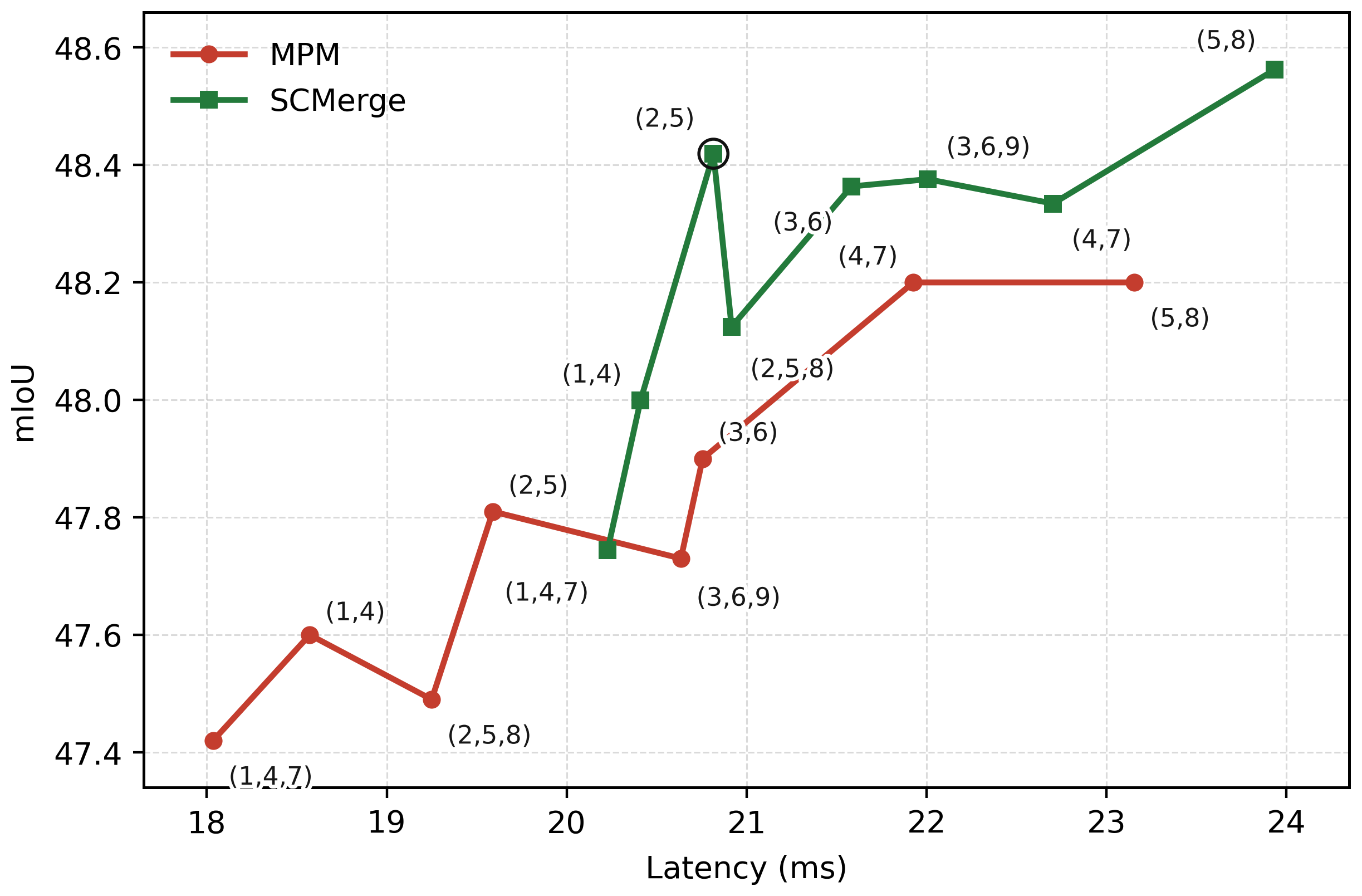
On ADE20K, Pascal Context, and Cityscapes with Segmenter backbones, SCMerge consistently improves the accuracy–efficiency trade-off over feature-similarity-only baselines. On ADE20K with Segmenter-B/16, SCMerge reaches 48.42 mIoU—within 0.06 of the unmerged baseline (48.48)—while reducing computation from 258.80 to 181.21 GFLOPs and latency from 29.77 ms to 20.82 ms.
Framework
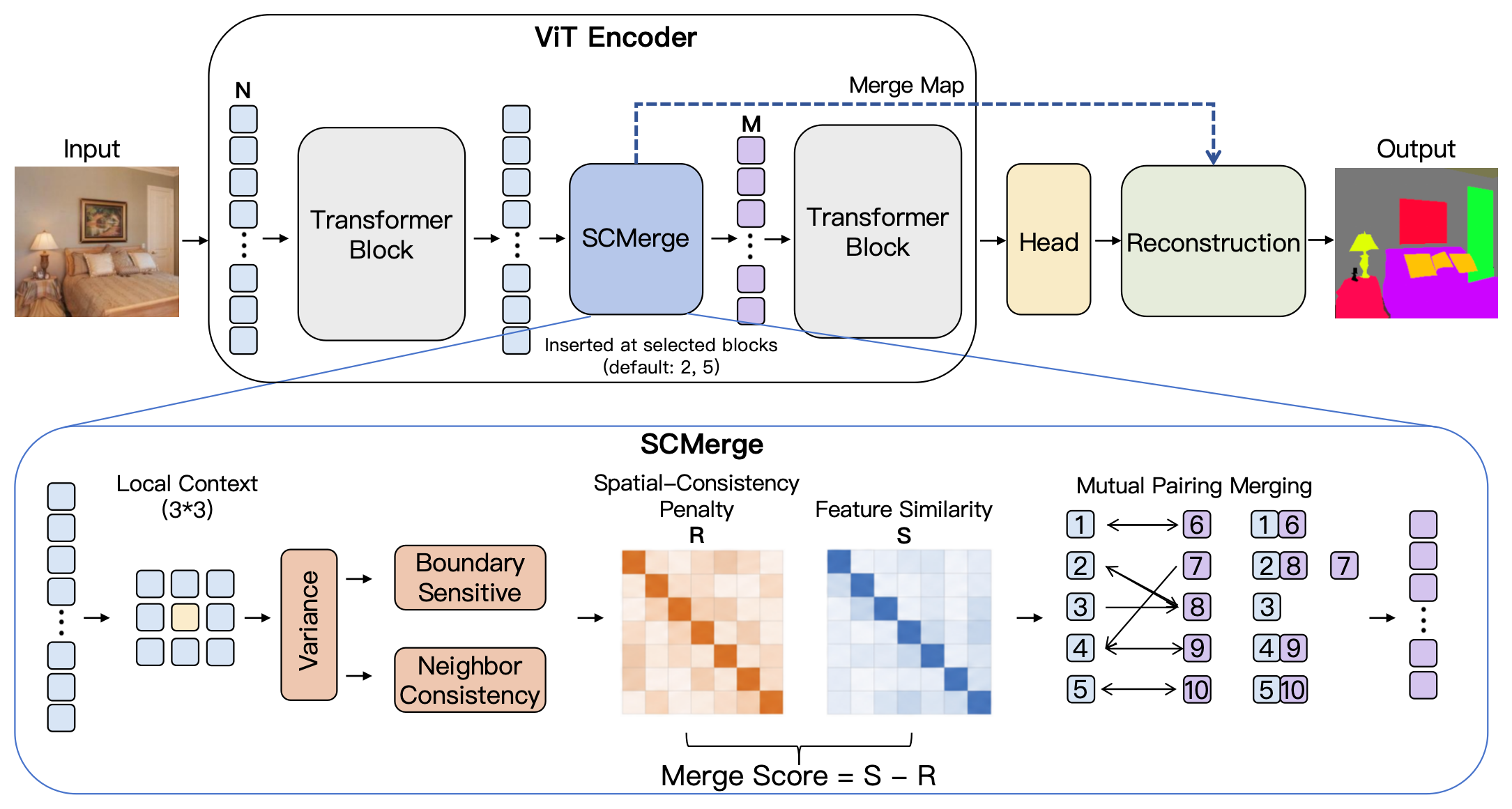
The pairing score combines feature similarity with a spatial-consistency penalty. The penalty has a boundary-sensitive term \(B_{ij}\) and a neighborhood consistency term \(D_{ij}\). Mutual nearest-neighbor pairs are merged inside the encoder. A merge map records which token represents each original patch so that decoder outputs can be reconstructed onto the original grid. The method adds no learnable parameters and leaves the segmentation decoder unchanged.
Key Contributions
- We propose a training-free token-pair merging method that adds a spatial-consistency penalty to feature-similarity matching, avoiding merges of locally similar but spatially incompatible tokens and improving the accuracy–efficiency trade-off.
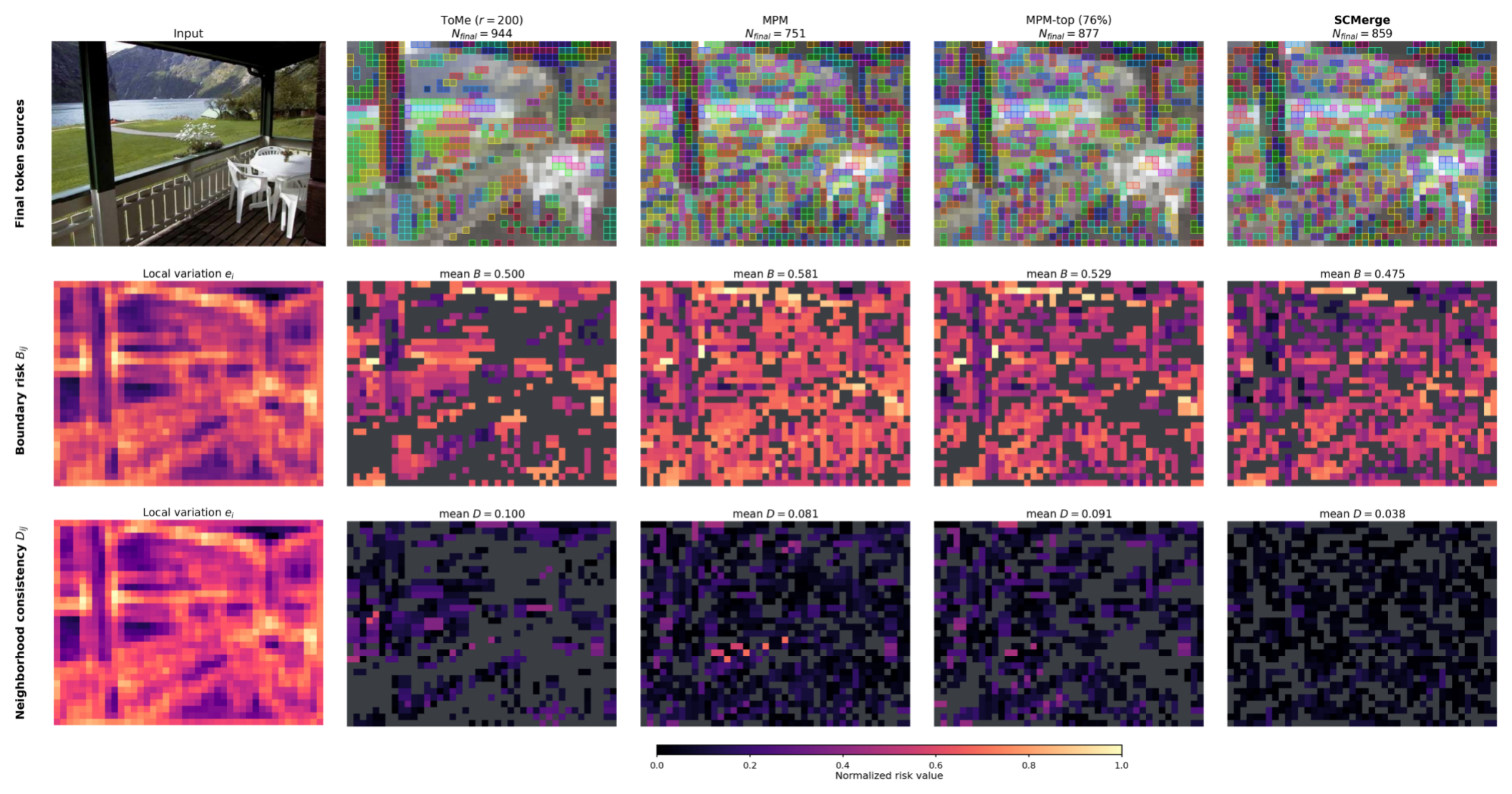
- We design a local feature variation metric to identify boundary-sensitive tokens, and a spatial-consistency penalty with a boundary-sensitive term and a neighborhood consistency term, to reduce incorrect merges near semantic boundaries and preserve fine spatial detail.
- Extensive experiments show that the method can be integrated into ViT-based semantic segmentation models and achieves a better accuracy–efficiency trade-off than baselines that rely only on feature similarity.
Experimental Results
Latency is measured on an NVIDIA RTX 3090 with batch size 1 in FP32. The paper’s accuracy–latency trade-off ratio is
\[ R = \frac{\mathrm{Latency}_{\mathrm{full}} - \mathrm{Latency}_{\mathrm{method}}}{\mathrm{mIoU}_{\mathrm{full}} - \mathrm{mIoU}_{\mathrm{method}}}. \]
A larger \(R\) means more latency reduction per unit of accuracy drop.
Quantitative comparison
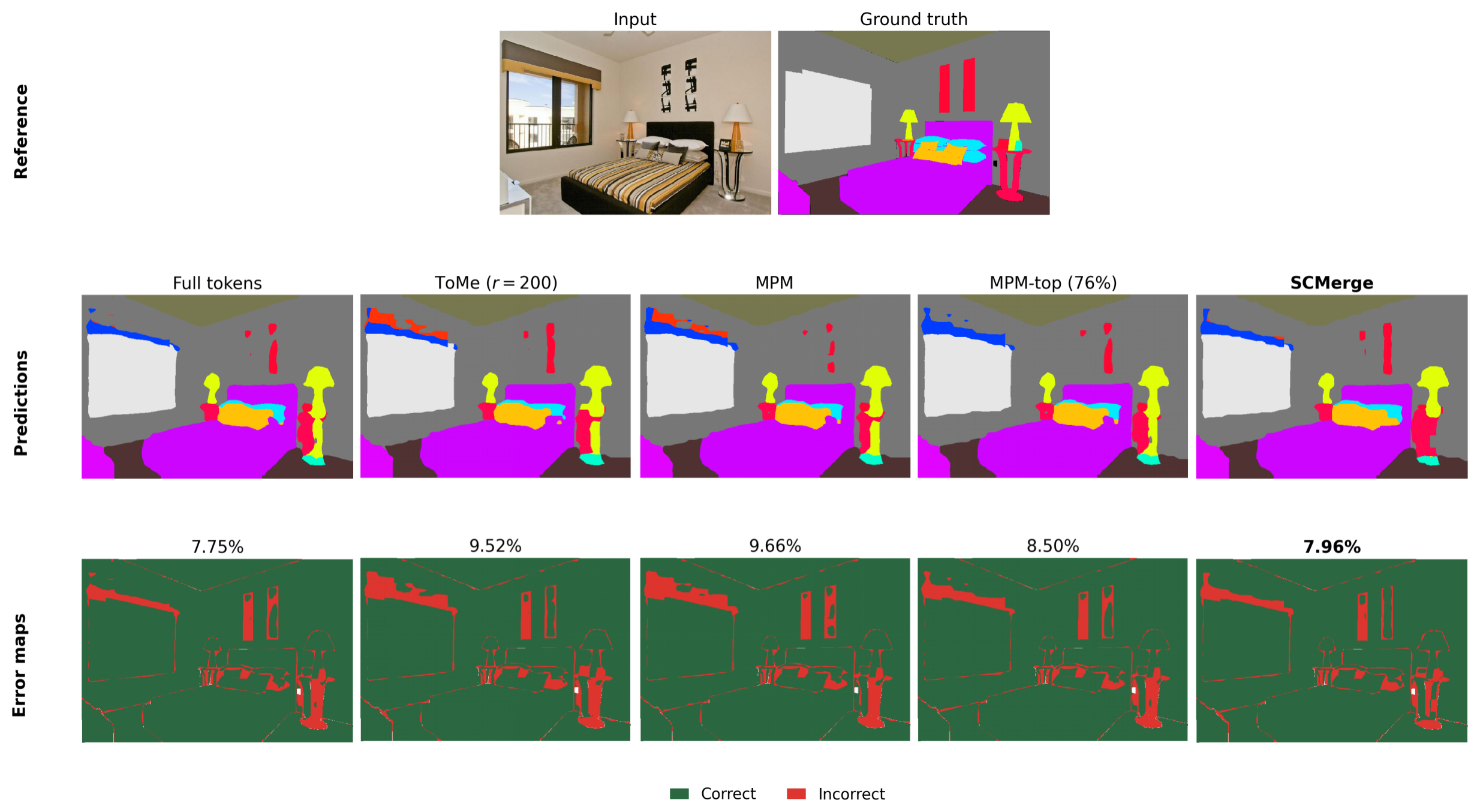
On ADE20K with Segmenter-B/16, SCMerge reaches 48.42 mIoU, within 0.06 of the unmerged baseline (48.48), while reducing computation from 258.80 to 181.21 GFLOPs and latency from 29.77 ms to 20.82 ms.
| Method | mIoU | Nfinal | GFLOPs | Latency (ms) | R ↑ |
|---|---|---|---|---|---|
| ADE20K, Segmenter-B/16 | |||||
| Segmenter | 48.48 | 1024.00 | 258.80 | 29.77 | – |
| ToMe (r=200) | 48.01 | 624.00 | 193.65 | 20.13 | 20.51 |
| MPM | 47.81 | 563.29 | 182.75 | 19.58 | 15.21 |
| MPM-top (76%) | 48.22 | 655.46 | 198.36 | 22.90 | 26.42 |
| SCMerge | 48.42 | 653.98 | 181.21 | 20.82 | 149.17 |
| ADE20K, Segmenter-B/8 | |||||
| Segmenter | 49.57 | 4096.00 | 1319.38 | 158.80 | – |
| ToMe | 49.15 | 2496.00 | 854.96 | 100.33 | 139.21 |
| MPM | 49.20 | 2247.40 | 802.61 | 91.81 | 181.05 |
| MPM-top | 49.26 | 2621.96 | 911.04 | 110.23 | 156.68 |
| SCMerge | 49.38 | 2639.09 | 908.26 | 107.86 | 268.11 |
| ADE20K, Segmenter-L/16 | |||||
| Segmenter | 51.81 | 1600.00 | 1343.32 | 134.13 | – |
| ToMe | 51.48 | 976.00 | 886.72 | 80.58 | 162.27 |
| MPM | 51.02 | 876.40 | 818.72 | 73.89 | 76.25 |
| MPM-top | 51.45 | 1020.21 | 919.94 | 89.29 | 124.56 |
| SCMerge | 51.64 | 1040.61 | 892.82 | 87.43 | 274.71 |
| Pascal Context, Segmenter-L/16 | |||||
| Segmenter | 58.08 | 900.00 | 685.67 | 56.89 | – |
| ToMe | 57.74 | 548.00 | 461.34 | 38.69 | 53.53 |
| MPM | 57.46 | 486.28 | 418.49 | 34.87 | 35.52 |
| MPM-top | 57.78 | 567.75 | 470.45 | 41.00 | 52.97 |
| SCMerge | 57.94 | 581.48 | 456.49 | 39.51 | 124.14 |
| Cityscapes, Segmenter-S/16 | |||||
| Segmenter | 76.35 | 2304.00 | 232.07 | 35.98 | – |
| ToMe | 75.43 | 1404.00 | 161.97 | 24.90 | 12.04 |
| MPM | 75.30 | 1334.67 | 159.70 | 24.42 | 11.01 |
| MPM-top | 75.52 | 1530.32 | 174.66 | 28.72 | 8.75 |
| SCMerge | 75.68 | 1565.60 | 162.22 | 26.52 | 14.12 |
| Cityscapes, Segmenter-L/16 | |||||
| Segmenter | 79.01 | 2304.00 | 2010.69 | 208.92 | – |
| ToMe | 78.03 | 1404.00 | 1266.86 | 125.36 | 85.27 |
| MPM | 77.72 | 1299.06 | 1190.04 | 118.68 | 69.95 |
| MPM-top | 78.23 | 1498.76 | 1346.05 | 133.54 | 96.64 |
| SCMerge | 78.48 | 1535.59 | 1337.82 | 132.80 | 143.62 |
My Contributions
First author.