SetSieve: Cost-Aware Structured Information Selection for Tool-Using Language Models
- 1 Independent Research
Submitted to Information Processing & Management
Overview
Tool-using language model agents repeatedly process structured observations whose fields are not equally useful for the current task. Removing information can shorten a prompt, but it can also break field dependencies, hide missing evidence, or create later recovery work. We formulate this decision as task-aware structured information selection under execution risk and cost constraints.
SetSieve constructs contract-valid views, distinguishes withheld information from observed absence, and predicts the downstream value of each view relative to the full response. An overhead-aware selector delivers a partial view or returns Full, acting once at the first supported structured read. Across AppWorld Test-Normal, Test-Challenge, and ToolSandbox with two Qwen3 backbones, SetSieve preserves 97.4%–98.7% of prompt-matched Full successes while reducing complete-episode input tokens by 8.3%–12.7% and elapsed time by 3.2%–5.3%.
Framework
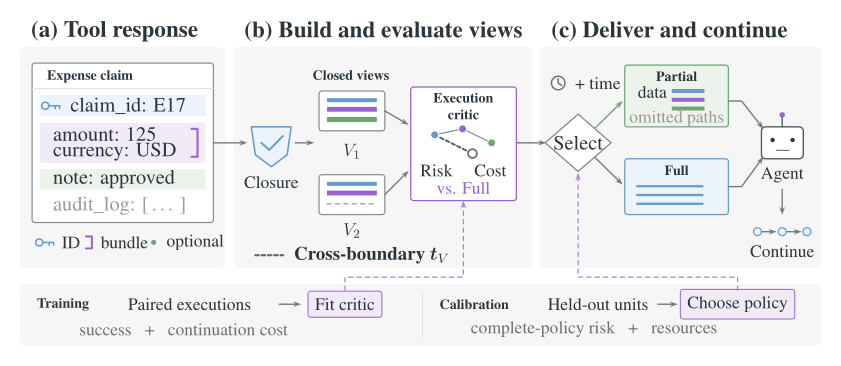
Endpoint contracts define which field groups must remain together. Contract closure constructs valid candidate views, and a typed omission envelope records which original paths were withheld. A shared-reference execution critic compares each candidate with the same Full continuation. The selector accepts a view only when its predicted regression and resource differences meet the operating thresholds, including measured selector time; otherwise it delivers Full. The policy makes one decision at the first supported structured read; later observations remain Full.
Key Contributions
- Contract-constrained structured information selection. We formulate retention within a returned response as a constrained evidence-selection problem and combine closure with omission-aware delivery. This separates declared structural consistency from the task sufficiency that must be learned from execution.
- Execution-aware value prediction and selection. We develop a shared-reference critic for whole candidate views and an overhead-aware decision rule. The combination evaluates whether information removal repays its downstream and selection costs, rather than optimizing local response length.
- End-to-end evidence and distribution-scoped risk calibration. Complete episodes on AppWorld and ToolSandbox connect information selection to task utility and resource use. Fixed-selection delivery controls isolate omission semantics, common-pool comparisons assess execution prediction, and independent calibration tests the complete policy on a controlled distribution.
Experimental Results
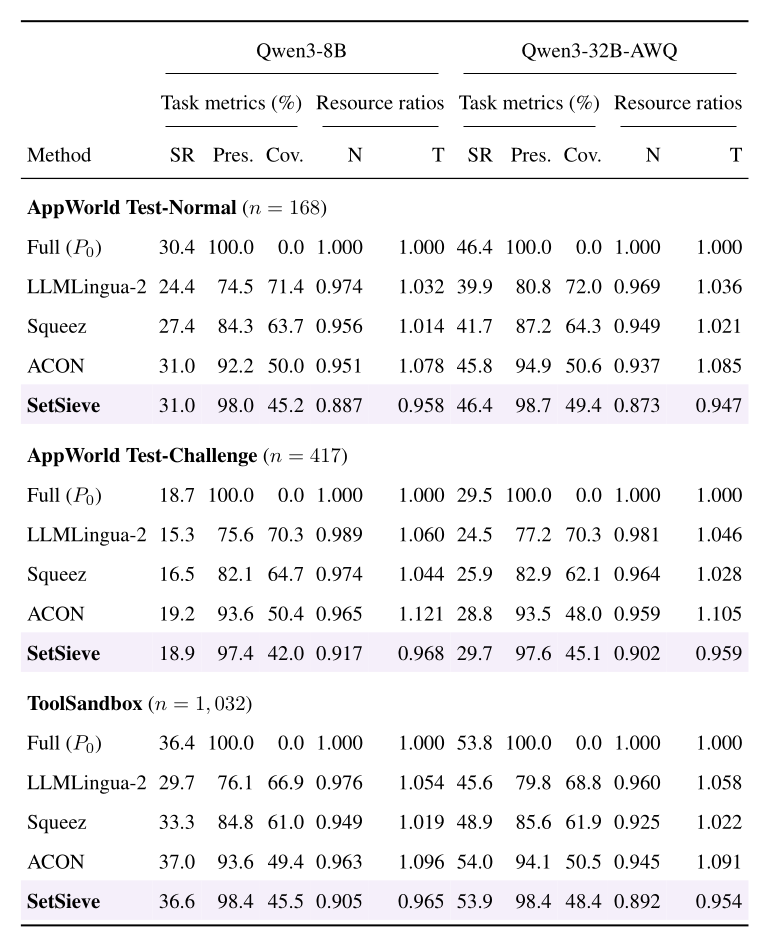
Across the six benchmark–backbone settings, SetSieve preserves 97.4%–98.7% of prompt-matched Full successes and reduces complete-episode input tokens by 8.3%–12.7% and elapsed time by 3.2%–5.3%.
| Method | Qwen3-8B | Qwen3-32B-AWQ | ||||||||
|---|---|---|---|---|---|---|---|---|---|---|
| SR | Pres. | Cov. | N | T | SR | Pres. | Cov. | N | T | |
| AppWorld Test-Normal (n = 168) | ||||||||||
| Full (P0) | 30.4 | 100.0 | 0.0 | 1.000 | 1.000 | 46.4 | 100.0 | 0.0 | 1.000 | 1.000 |
| LLMLingua-2 | 24.4 | 74.5 | 71.4 | 0.974 | 1.032 | 39.9 | 80.8 | 72.0 | 0.969 | 1.036 |
| Squeez | 27.4 | 84.3 | 63.7 | 0.956 | 1.014 | 41.7 | 87.2 | 64.3 | 0.949 | 1.021 |
| ACON | 31.0 | 92.2 | 50.0 | 0.951 | 1.078 | 45.8 | 94.9 | 50.6 | 0.937 | 1.085 |
| SetSieve | 31.0 | 98.0 | 45.2 | 0.887 | 0.958 | 46.4 | 98.7 | 49.4 | 0.873 | 0.947 |
| AppWorld Test-Challenge (n = 417) | ||||||||||
| Full (P0) | 18.7 | 100.0 | 0.0 | 1.000 | 1.000 | 29.5 | 100.0 | 0.0 | 1.000 | 1.000 |
| LLMLingua-2 | 15.3 | 75.6 | 70.3 | 0.989 | 1.060 | 24.5 | 77.2 | 70.3 | 0.981 | 1.046 |
| Squeez | 16.5 | 82.1 | 64.7 | 0.974 | 1.044 | 25.9 | 82.9 | 62.1 | 0.964 | 1.028 |
| ACON | 19.2 | 93.6 | 50.4 | 0.965 | 1.121 | 28.8 | 93.5 | 48.0 | 0.959 | 1.105 |
| SetSieve | 18.9 | 97.4 | 42.0 | 0.917 | 0.968 | 29.7 | 97.6 | 45.1 | 0.902 | 0.959 |
| ToolSandbox (n = 1,032) | ||||||||||
| Full (P0) | 36.4 | 100.0 | 0.0 | 1.000 | 1.000 | 53.8 | 100.0 | 0.0 | 1.000 | 1.000 |
| LLMLingua-2 | 29.7 | 76.1 | 66.9 | 0.976 | 1.054 | 45.6 | 79.8 | 68.8 | 0.960 | 1.058 |
| Squeez | 33.3 | 84.8 | 61.0 | 0.949 | 1.019 | 48.9 | 85.6 | 61.9 | 0.925 | 1.022 |
| ACON | 37.0 | 93.6 | 49.4 | 0.963 | 1.096 | 54.0 | 94.1 | 50.5 | 0.945 | 1.091 |
| SetSieve | 36.6 | 98.4 | 45.5 | 0.905 | 0.965 | 53.9 | 98.4 | 48.4 | 0.892 | 0.954 |
My Contributions
Sole author. Independent research.