SPOT: Parameter-Efficient Evolutionary Optimization for Speech Deepfake Detection
- 1 Shenzhen Loop Area Institute (SLAI), Shenzhen
- 2 National University of Singapore, Singapore
- 3 Harbin Institute of Technology, Shenzhen
- 4 New York University, New York
- 5 The Chinese University of Hong Kong, Shenzhen
† Equal contribution. ∗ Corresponding author (Siqi Cai).
Submitted to IEEE ICASSP 2027
Overview
Speech deepfake detectors often degrade under shifts in coding, acoustics, or generative models. Most post-training adaptation still relies on backpropagation, and it remains unclear which parameter regions should be updated, or how many parameters to change.
We propose SPOT (Speech Parameter Optimization in Targeted Subspaces), a gradient-free evolutionary framework that decouples the candidate parameter region from the actual search dimension. SPOT evolves only selected coordinates under a fixed budget, using source-domain forward evaluations. It requires neither target-domain feedback nor backpropagation; unselected parameters stay frozen, and checkpoints are chosen only on the source development set.
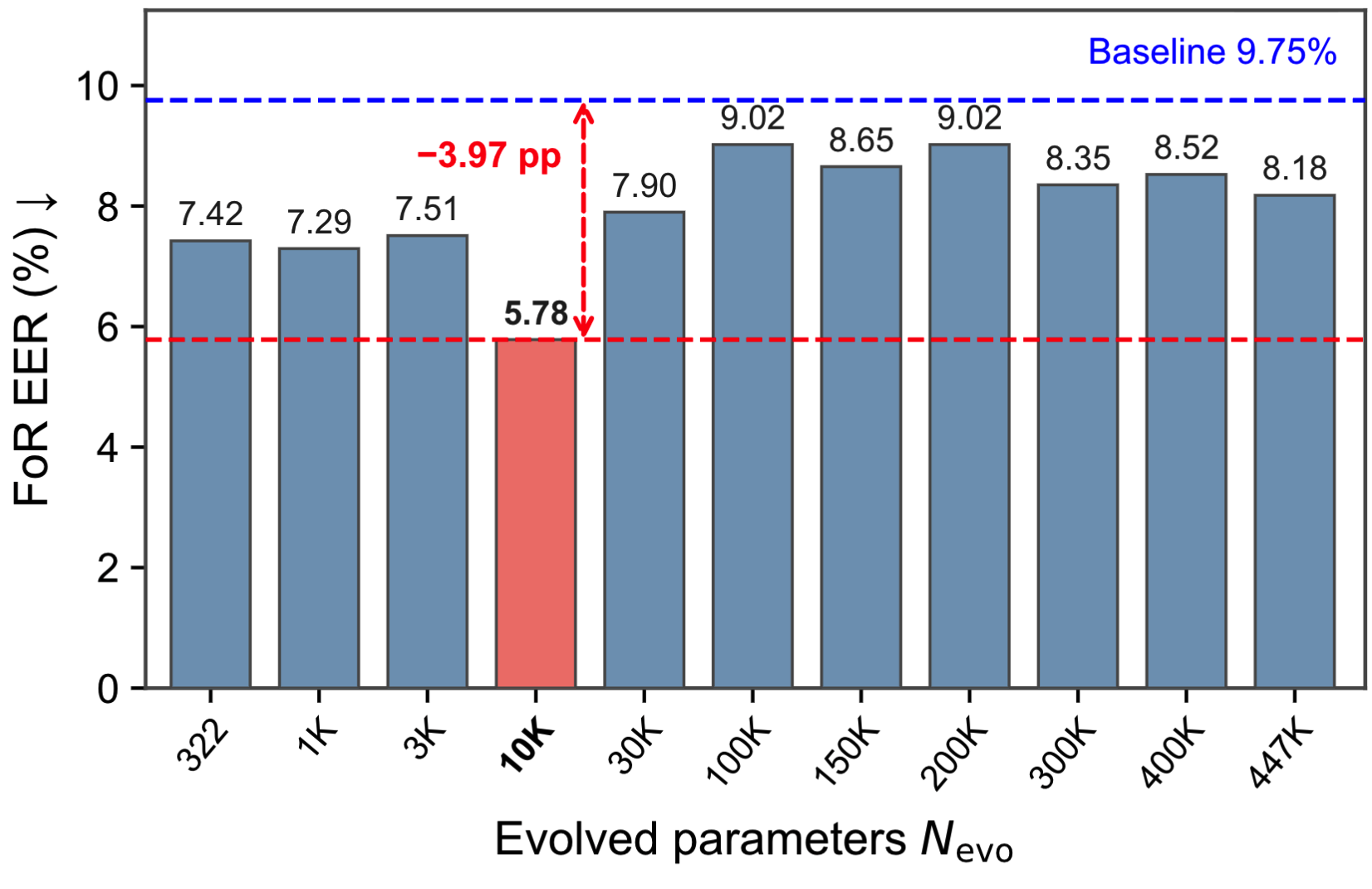
Across five XLS-R-based detectors and three unseen target domains, SPOT reduces equal error rate (EER) in every model–domain pair. On XLSR-AASIST, evolving 10,000 parameters—about 0.003% of the full model, or 30 ppm—lowers FoR EER from 9.75% to 5.78%. Further studies show that compact, task-relevant subspaces are generally more effective than broader searches, and that high-gain updates concentrate in limited structural regions.
Framework
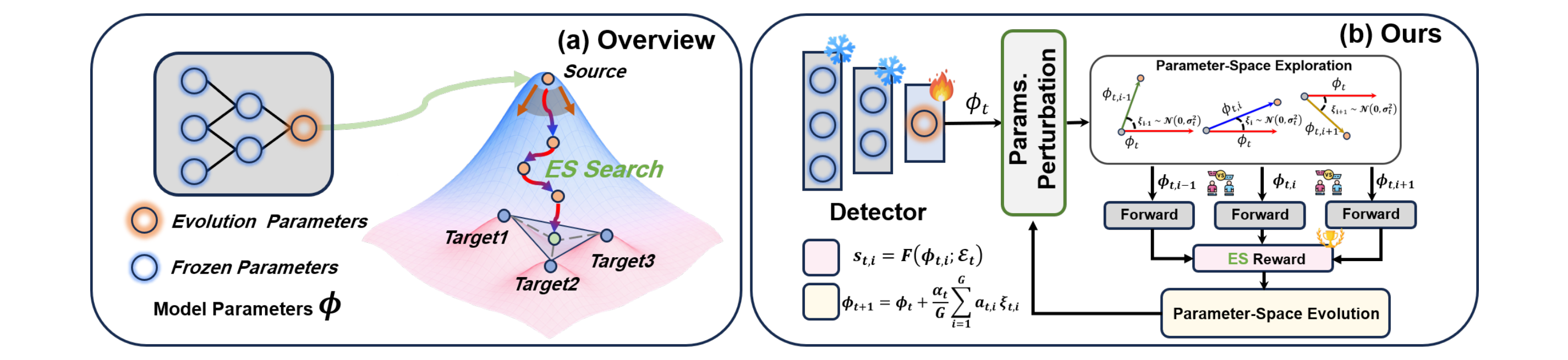
Targeted subspace. SPOT first selects a structural region r, then a fixed coordinate set Ir,k of size Nevo. The parameter location and the search dimension are controlled separately.
Evolutionary update. Each generation perturbs only those coordinates, evaluates G candidates with source-domain forward passes, and aggregates them by reward. Other parameters stay frozen. The implementation uses G = 32 and T = 128, with 512 class-balanced source utterances per generation (4096 candidate forwards), α = 0.04, and σ decaying from 0.02 to 0.002.
Data protocol. Optimization uses the ASVspoof 2019 LA training set, and checkpoints are selected on its development set. The target domains 21DF, ITW, and FoR are used only for final EER tests. The XLS-R encoder stays frozen. The five detectors are XLSR-AASIST, XLSR-SLS, XLSR-Mamba, XLSR-MoE, and XLSR-Nes2Net-X.
Key Contributions
- We propose SPOT, an efficient, gradient-free evolutionary framework that separately controls parameter location and evolution dimension.
- We evaluate SPOT on five heterogeneous XLS-R-based detectors and three unseen target domains, achieving EER reductions for every model–domain combination.
- Controlled studies show that broader parameter regions or larger search dimensions do not necessarily improve performance, and that effective parameter locations and budgets are architecture-dependent.
Experimental Results
On XLSR-AASIST, evolving 10,000 parameters (30 ppm, about 0.003%) lowers FoR EER from 9.75% to 5.78% (−3.97 pp). Gains appear for every model–domain pair; 21DF gains are smaller (0.01–0.50 pp).
Cross-architecture and cross-domain EER
| System | EER (%) ↓ | Evolved Params | |||
|---|---|---|---|---|---|
| 21DF | ITW | FoR | Count | ppm | |
| Published systems | |||||
| XLSR-AASIST-SAM [19] | 3.44 | 6.34 | 5.18 | – | – |
| Wav2DF-TSL [33] | 1.95 | 6.83 | – | – | – |
| XLSR-Conformer-TCM [11] | 2.06 | 7.79 | 10.68 | – | – |
| XLSR-LSR+LSA [34] | 1.86 | 5.54 | – | – | – |
| XLSR-WavSpec [35] | 1.90 | 6.58 | – | – | – |
| Paired SPOT evaluation | |||||
| XLSR-AASIST | 2.30 | 10.46 | 9.75 | – | – |
| + SPOT | 1.80 | 7.12 | 5.78 | 10,000 | 30.0 |
| Δ EER | −0.50 | −3.34 | −3.97 | – | – |
| XLSR-SLS | 1.77 | 7.46 | 5.03 | – | – |
| + SPOT | 1.43 | 6.17 | 2.95 | 512 | 1.5 |
| Δ EER | −0.34 | −1.29 | −2.08 | – | – |
| XLSR-Mamba | 1.82 | 9.23 | 6.58 | – | – |
| + SPOT | 1.69 | 8.01 | 4.38 | 147,456 | 462 |
| Δ EER | −0.13 | −1.22 | −2.20 | – | – |
| XLSR-MoE | 2.52 | 12.47 | 4.90 | – | – |
| + SPOT | 2.39 | 11.50 | 3.62 | 322 | 0.9 |
| Δ EER | −0.13 | −0.97 | −1.28 | – | – |
| XLSR-Nes2Net-X | 1.65 | 8.41 | 6.09 | – | – |
| + SPOT | 1.64 | 7.29 | 4.05 | 256 | 0.8 |
| Δ EER | −0.01 | −1.12 | −2.04 | – | – |
SLS, MoE, and Nes2Net-X work best on a compact Classification Head; XLSR-AASIST prefers Aggregation + Head; expanding to the Detector Body reduces the gain.
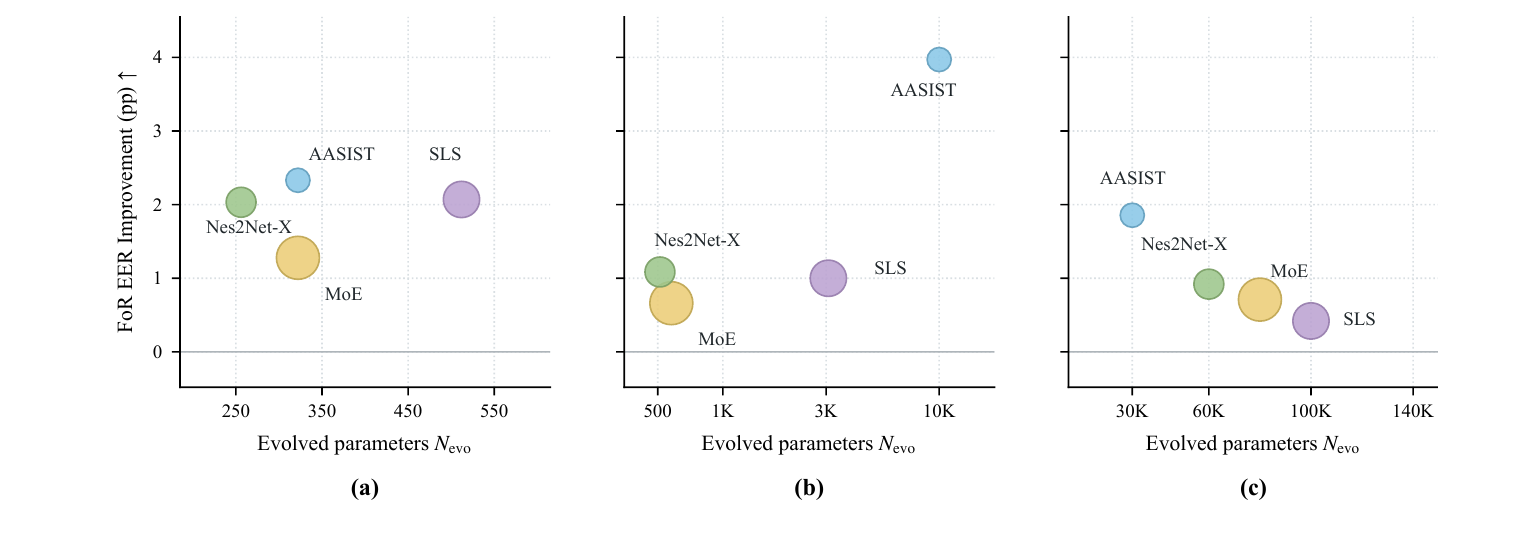
Parameter location on XLSR-AASIST
| Stage | Encoder | Graph & Head | FoR EER ↓ | Gain ↑ | ||||||
|---|---|---|---|---|---|---|---|---|---|---|
| BS | FP | LC-F | LC-B | SG | TG | GA | Cls | |||
| – | 9.75 | – | ||||||||
| Front | ✓ | 7.64 | 2.12 | |||||||
| Middle | ✓ | 7.49 | 2.26 | |||||||
| ✓ | 6.84 | 2.91 | ||||||||
| ✓ | 6.97 | 2.78 | ||||||||
| Late | ✓ | 7.90 | 1.86 | |||||||
| ✓ | 8.31 | 1.45 | ||||||||
| ✓ | 8.35 | 1.40 | ||||||||
| ✓ | 6.38 | 3.37 | ||||||||
| ✓ | ✓ | 5.78 | 3.97 | |||||||
Among single modules, the Classifier is best (6.38%, 3.37 pp). Graph Aggregation together with the Classifier is best overall (5.78%, 3.97 pp).
My Contributions
Equal contribution with Sihan Gao; corresponding author: Siqi Cai.